Oxford, says, in a letter to Strype, “He was inclined to believe the observation of Tillotson was true.” THOMAS HEARNE, however, speaks of Fox in a different strain, and says, “Et tamen agnosco Foxi, Martyrologium quod tantopere laudatur, mendaciorum magna ex parte esse farraginem.” Dr. CHARLET, when noticing this bitter invective, says, “I am concerned for the credit of Mr. Fox and his history, and therefore not a little offended at the vain and bold malice of T. H., who has abused many of all ranks, always in favour of Popery, and against the Reformation.” Dr. THOMAS WARTON also says, “Fox, the Martyrologist, a weak and a credulous compiler.”1 WARTON also says, “Thomas Brice, at the accession of Elizabeth, printed in English metre a ‘Register of the Martyrs and Confessors under Queen Mary,’ this was published in London 1559. I know not how far Fox might profit by this work, I think he has not mentioned it.”2
The character of John Fox, and of his great work, the “Martyrology,” appears to be impartially described in the following passage:---
“The united testimony of his contemporaries and immediate successors, in their comments on his character, bear witness to his laborious industry, learning, and integrity of principle. He was a Calvinist in doctrine, and a Nonconformist in the articles of the ceremonies and habits, and could never bring his mind to subscription; this is not denied by any one. His were times of strong party spirit, and great theological controversy, and he must have been more than man to have resisted the current of popular feeling and opinion. He had been long resident in Germany, and had taken an active part in the controversies, which have been termed the ‘troubles of Frankfort.’ He had heard from England of the diabolical cruelties that marked the Marian persecutions, and he was then deeply engaged in the compilation of his ‘Acts and Monuments,’ for which the materials were of such a nature as to excite his hatred against the Church of Rome, and all the members of that communion. His spirit was bold, and his zeal led him to write without restraint the sincere result of his reflections. That he has been guilty of many mistatements and exaggerations, both from erroneous information and the credulity of the age, cannot be doubted: but his various corrections of the several editions of his work, during his lifetime, and his private correspondence preserved in the Harl. MSS., testify his willing ness to submit to, and adopt the corrections which were discovered by others. The Acts and Monuments,’ as an historical and biographical work, independent of its personal and polemical character, will still be, as it always has been, one of the standard works in the Theological Library, and all who admire integrity, industry, and leaning, must ever cherish a high esteem for the memory of John Fox.”
The house in Boston in which Fox was born is represented as it appeared in 1799, at page 225 of this volume. The Records of the Corporation of Boston, which commence in 1545, furnish only one entry which can be connected with time family of the Martyrologist: “John Foxe, draper, was, in 1567, one of the committee to prevent people washing clothes at the pumps or pits.” The name of John Foxe occurs again in 1576.
|
The Parish Registers commence in 1565, and contain only the following entries "Joan Foxe, married to Anthony Williamson,
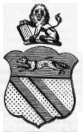
9th July, 1566. Dr. MAITLAND gives the annexed as the arms of the Fox family, taken from a patent of arms dated 1598. |
|